Understanding the Development Phases of Dholera Smart City
Dholera Special Investment Region (DSIR) is India’s first greenfield industrial smart city, spanning 920 sq. km. Investors seeking opportunities in Dholera must understand its phased development model, as the timing of infrastructure, industrial activity, and urban expansion directly affects returns and risk.
The first operational phase, the Activation Area, covers 22.54 sq. km under TP 2A and 4A, with trunk infrastructure fully developed. Subsequent phases are planned systematically, each offering different levels of investment visibility and risk.
Understanding Dholera development phases helps investors distinguish near-term actionable opportunities from long-term growth potential. Aligning investment decisions with verified infrastructure, TP-approved zones, and sector-specific demand mitigates speculation risk.
Key Takeaways for Investors
- Infrastructure completion is the primary driver of early-phase value.
- Phase-based timing helps manage risk and liquidity expectations.
- Industrial and logistical demand sets the foundation for urban and commercial growth.
Overview of Dholera Development Phases
Dholera SIR is planned to evolve in three main phases: infrastructure activation, industrial scaling, and urban expansion. Each phase defines an investment opportunity, potential returns, and risk profile.
Phase | Area / TP Scheme | Key Features | Investment Insights |
Phase 1: Activation Area | 22.54 sq. km (TP 2A & 4A) | Roads, utilities, power, water treatment, ABCD building, CIOC | Low-risk, industrial-ready investment |
Phase 2: Industrial Scaling | TP1, TP2 expansion | Emerging industrial hubs, expressway, freight rail, planned airport | Medium-term growth; monitor industrial uptake |
Phase 3: Urban Expansion | TP3–TP6 | Residential, commercial, social infrastructure | Long-term investment; capital appreciation focus |
Phase 1: Activation Area – Core Infrastructure
The Activation Area is the first operational segment of Dholera Smart City. Key infrastructure elements include:
- Road network: 72 km of internal roads with dedicated pedestrian paths and utility corridors.
- Utilities: Underground systems for water, sewage, storm drainage, gas, and ICT networks.
- Water infrastructure: A 50 MLD Water Treatment Plant, scalable to 150 MLD, ensures a reliable industrial and residential water supply.
- Waste management: A 10 MLD Sewage Treatment Plant (STP) and 20 MLD Common Effluent Treatment Plant (CETP), scalable to 30 MLD and 60 MLD, respectively.
- Power supply: Two advanced 400/220 kV SCADA-enabled substations with current distribution capacity of 500 MVA, scalable to 1500 MVA.
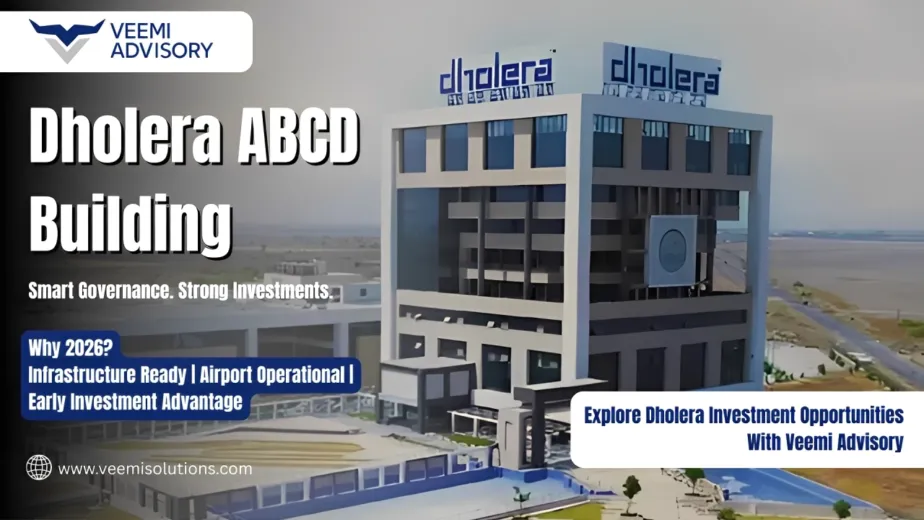
- City management: The ABCD Building hosts the City Integrated Operations Center (CIOC) for monitoring and regulation of utilities, traffic, and emergency services.
Investor Insights
The Activation Area provides the clearest investment visibility due to completed infrastructure. Industrial-ready plots are the most reliable for short- to medium-term returns. Investors should prioritize assets linked to operational roads, utilities, and power distribution.
Focus on industrial-ready parcels and monitor ongoing allotments, as land here is already integrated with the city’s operational backbone.
Phase 2: Industrial Anchoring and Connectivity
Phase two focuses on industrial demand creation and the integration of external connectivity.
Key Features
- Targeted high-value sectors include semiconductors, electronics manufacturing, and sunrise industries.
- Connectivity infrastructure: Ahmedabad-Dholera Expressway (109 km, greenfield controlled-access road).
- Bhimnath-Dholera freight rail line for industrial logistics.
- Planned Dholera International Airport (20 km) to serve both cargo and passenger traffic.
- Industrial activity in this phase begins to anchor demand, improving the commercial and residential market for later phases.
Investor Insights
Investors should monitor industrial land uptake and operational activity. Proximity to expressways, freight rail lines, and the airport is a key factor for long-term appreciation.
Phase two is ideal for medium-term investors looking to capitalize on industrial growth, while remaining cautious about speculative claims in undeveloped TP zones.
Phase 3: Urban Expansion, Residential & Commercial Growth
Phase three represents the urban maturation of Dholera, combining residential, commercial, and social infrastructure development.
Key Features
- Residential, retail, hospitality, and service sector growth follows industrial expansion.
- Social infrastructure: healthcare, education, fire and police services, hotels, and community facilities.
- TP3–TP6 zones are designed for long-term growth, with phased urbanization aligned to industrial and transport hubs.
Investor Insights
Residential and commercial opportunities are suitable for long-term investment horizons. Monetization through rentals or sales will be phased, and returns are heavily dependent on industrial activity in earlier phases.
Early investors should align property selection with phase-specific infrastructure completion to minimize holding risk.
Key Challenges for Investors
Investing in Dholera requires understanding the risks associated with a phased smart city:
- Speculative marketing: Not all parcels are backed by infrastructure; investors must verify TP approvals and utility availability.
- Timeline mismatch: Urban and commercial development often lags industrial growth.
- Legal & zoning complexity: Confirm title, permitted use, and development permissions.
- Liquidity and holding period: Early-phase plots require long-term planning; short-term resale may be challenging.
Mitigation Strategies
- Conduct thorough due diligence on the plot phase, infrastructure, and legal compliance.
- Focus on areas with operational or near-complete infrastructure.
- Align investment decisions with phase-specific growth and realistic exit timelines.
Risk Management and Due Diligence Checklist
Investing in Dholera requires careful attention to risk, especially in a large-scale smart city that is being developed in stages. Key risk factors include speculative marketing, zoning ambiguities, and delayed urban development.
A structured due diligence checklist can help mitigate these risks:
- TP Scheme Verification: Confirm the plot falls within an approved Town Planning Scheme (TP 2A, 4A, or other active phases).
- Infrastructure Audit: Verify operational status of roads, power, water treatment, wastewater management, and ICT networks.
- Legal Compliance: Check title documents, permitted land use, and development permissions from DSIRDA.
- Industrial Anchoring: Assess whether nearby plots or sectors have active industrial occupancy that can drive future demand.
- Exit Horizon Planning: Align investment horizon with the development phase, Activation Area for near-term visibility, Phase 2 or later for longer-term capital appreciation.
Applying these due diligence measures ensures that investors make informed decisions and avoid common pitfalls associated with early-stage smart city investments.
How to Evaluate Dholera Development Phases Before Investing
A disciplined approach includes:
- Confirming the TP scheme and phase of the plot.
- Assessing operational road, power, and utility networks.
- Reviewing industrial and logistical anchors for long-term demand.
- Verifying land use compliance and development permissions.
- Matching investment horizon to the phase’s maturity level.
This approach reduces speculation and ensures alignment with infrastructure-backed opportunities.
Investment Timing and Capital Allocation Strategies
Timing is a crucial factor in Dholera real estate and industrial land investments. Early-phase properties in the Activation Area may require higher upfront capital, but they also provide lower execution risk due to completed infrastructure.
Later-phase zones may be more affordable per acre but carry a longer horizon and higher uncertainty in terms of infrastructure completion and urban absorption.
Investors should consider staggering investments across different phases. Allocating capital between operational plots in the Activation Area and medium-term parcels in Phase 2 allows for diversification of risk while maintaining exposure to long-term appreciation.
This approach also helps investors adapt to the industrial and urban rollout schedule, avoiding overcommitment to speculative land parcels.
Actionable Tips:
- Conduct a phased capital deployment aligned with infrastructure progress.
- Prioritize plots with verified road, water, and power connectivity.
- Regularly monitor industrial uptake and urban development trends to adjust allocation.
Why Phase-Based Investing Beats Hype
Dholera’s phased approach: planning → infrastructure → industrial activation → urban expansion provides a predictable framework for value creation.
Investors focusing on completed or near-complete phases reduce risk and increase the reliability of long-term returns. Unlike hype-driven decisions, phase-based strategies rely on tangible, operational infrastructure and verified industrial demand.
Book a consultation with us at Veemi Solutions to discover how our solutions can help you evaluate Dholera development phases, assess risk, and identify the right entry strategy.
FAQs
A: The 22.54 sq. km Activation Area under TP 2A & 4A, with fully developed trunk infrastructure.
A: TP 2A and TP 4A.
A: TP scheme, infrastructure readiness, land use compliance, development permissions, and realistic holding periods.
A: Semiconductors, Electronics Manufacturing Services, and other high-growth sectors designated under the Gujarat Semiconductor Policy 2022.
A: Through highways, the planned freight rail line, and the future Dholera International Airport.