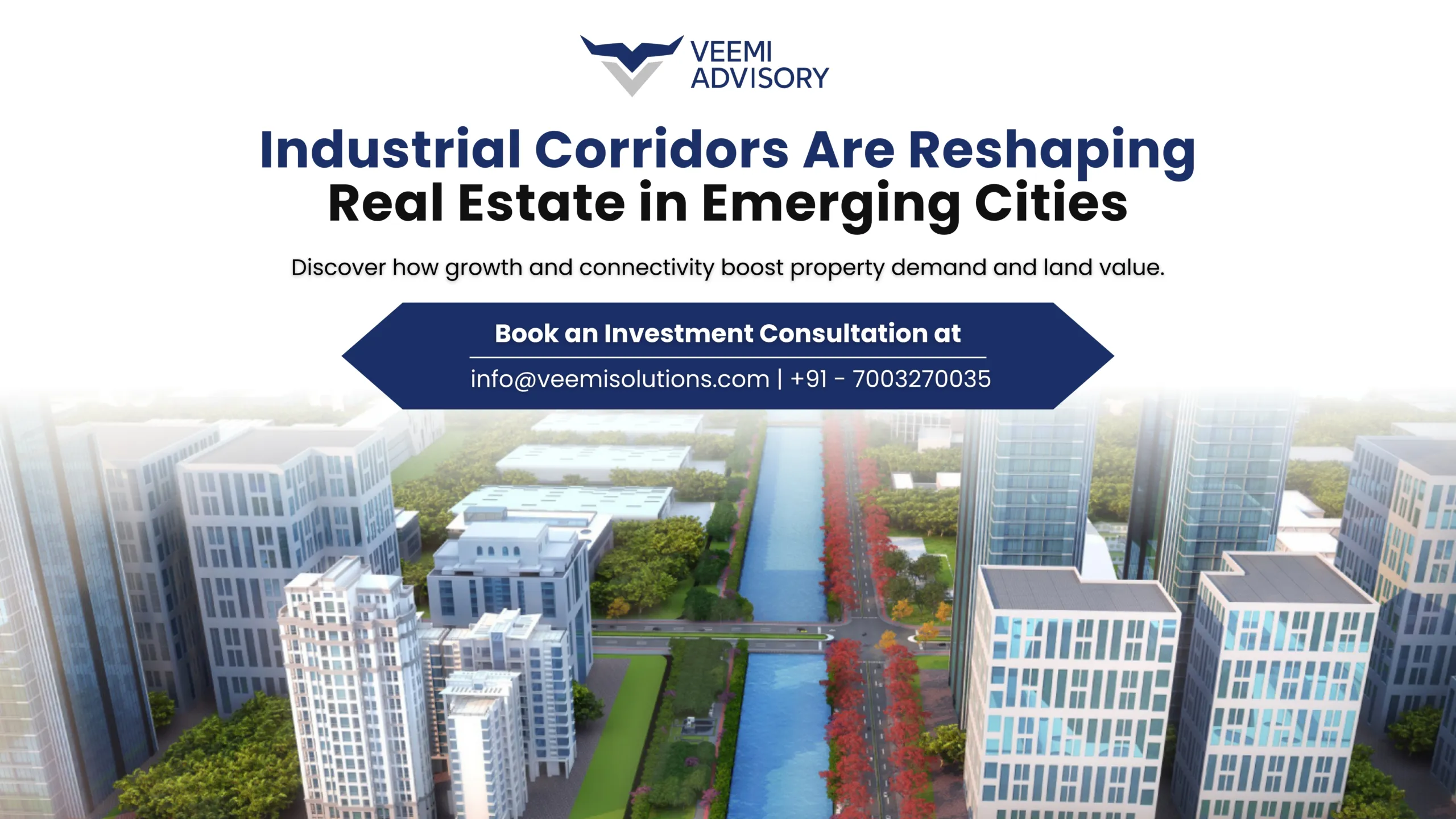
How Industrial Corridors Influence Real Estate Growth in Emerging Cities
Industrial corridors are changing how investors evaluate emerging-city real estate. They are no longer seen only as infrastructure projects built for manufacturing and logistics.
In practice, they can reshape land demand, improve connectivity, attract business activity, and accelerate the growth of residential, commercial, and industrial property markets around them.
For investors, the key question is not whether industrial corridors matter, but how to identify where corridor-led growth is translating into real estate value.
Why industrial corridors matter in real estate
Industrial corridors influence property markets because they do more than support goods movement. They create a wider economic ecosystem.
That ecosystem often includes:
- transport and logistics infrastructure
- industrial and warehousing demand
- workforce migration
- commercial activity
- housing demand
- long-term urban expansion
For investors studying industrial corridor real estate, emerging city real estate growth, and infrastructure-led property investment, this matters because real estate value tends to rise where infrastructure improves usability and business activity supports demand. The opportunity is strongest when growth is backed by execution, not only by announcements.
What makes emerging cities especially important
Emerging cities often benefit the most from industrial corridors because they start from a lower base. Land is usually cheaper, urban density is lower, and infrastructure improvements can have a larger effect on future value.
Why investors watch these markets closely
- Lower entry cost compared with mature cities
- Higher re-rating potential as infrastructure improves
- More room for planned urban and industrial expansion
- Opportunity to enter before institutional competition increases
But there is also a catch
Early-stage markets can also carry:
- execution risk
- legal and regulatory complexity
- uneven infrastructure progress
- liquidity challenges
- overpricing driven by market sentiment
This is where research-led advisory becomes valuable. They are focused on a data-backed strategy that helps investors minimise risk and maximise returns, supported by services such as market insights, investment advisory, and risk assessment.
How industrial corridors drive real estate growth
Industrial corridors influence property values through several connected mechanisms. Investors who understand these mechanisms are better able to judge whether a corridor-led market is truly investable.
1. Connectivity increases land usability
The first major shift usually comes from better infrastructure. When a corridor improves road access, logistics connectivity, and regional movement, previously peripheral land becomes more usable.
This can influence:
- industrial plot demand
- warehousing and logistics space
- roadside commercial activity
- residential projects for workers and managers
- supporting social infrastructure over time
Land becomes more valuable when connectivity improves practical access, not simply when a location gets mentioned in growth narratives.
2. Industrial activity creates layered demand
Industrial corridors do not create only factory demand. They create secondary and tertiary property demand as employment and business ecosystems grow.
This often leads to demand for:
- worker housing
- management housing
- rental accommodation
- retail services
- commercial offices
- hospitality and service clusters
For investors, this is important because real estate around industrial corridors often performs best when demand is diversified, not dependent on a single asset type.
3. Job creation strengthens residential markets
As industrial projects attract businesses, they also attract people. Workforce movement supports the expansion of local residential markets, particularly in plotted development, affordable housing, rental housing, and integrated communities.
A simple way to view it:
- More industry can lead to more jobs
- More jobs can lead to more migration
- More migration can lead to more housing demand
- More housing demand can lift surrounding land values
Housing demand near industrial corridors should be assessed through employment quality and business concentration, not only through citywide population assumptions.
4. Commercial absorption improves over time
Once a corridor becomes active, business support services begin to follow. That can improve commercial real estate prospects in emerging cities.
Examples include:
- Office demand for service providers
- retail for daily consumption
- fuel, maintenance, and roadside services
- food and hospitality businesses
- banking and professional services
The most attractive markets are usually those where industrial expansion is strong enough to support a broader commercial ecosystem.
5. Market confidence increases when execution becomes visible
In emerging cities, confidence usually shifts in phases. At first, interest is driven by announcements. Later, confidence improves when infrastructure, land activity, and industrial occupancy become visible.
That distinction matters because:
- Sentiment can move prices quickly
- Execution determines whether those prices are sustainable
This is one reason Veemi highlights sector intelligence, strategic foresight, and outcome-based delivery in its positioning. In corridor-led markets, investors need evidence-backed decision-making rather than generic optimism.
What investors should evaluate before investing
Industrial corridor markets can be attractive, but disciplined screening is essential.
Core evaluation points
- Location quality: proximity to highways, transport links, industrial nodes, and growing urban centres
- Current infrastructure status: planned, under construction, or operational
- Demand type: industrial, residential, logistics, commercial, or mixed
- Regulatory clarity: title, approvals, land use, compliance status
- Holding horizon: short-, medium-, or long-term strategy
- Exit visibility: resale demand, liquidity, and buyer depth
Small but critical checks
- Micro-location matters more than city-level hype
- Price appreciation should be compared with actual usability
- Early entry only works if the investor can absorb longer holding periods
- Corridor growth is uneven, not universal
Investment opportunities by asset type
Different investors benefit from different asset classes in corridor-led cities.
Asset type | Why it gains from industrial corridors | Key investor consideration |
Industrial land | Benefits from manufacturing and logistics expansion | Requires strong understanding of zoning, access, and approvals |
Warehousing/logistics assets | Gains from supply-chain movement and transport connectivity | Best where corridor traffic becomes commercially active |
Residential plots or housing | Supported by workforce migration and growing local demand | Stronger where employment and social infrastructure develop together |
Commercial spaces | Benefits from rising business services and local consumption | More viable after visible industrial activation |
Mixed-use opportunities | Gains from long-term urbanization around corridor nodes | Needs patient capital and strong market timing |
Common challenges investors face today
Industrial corridor investing is attractive, but it is not frictionless. Current challenges in emerging-city markets usually fall into four categories.
1. Execution risk
A corridor announcement does not automatically create immediate real estate value. Investors need to distinguish between approved projects and operational progress.
2. Information asymmetry
Emerging markets often have fragmented data and aggressive sales narratives. This makes independent market research essential.
3. Regulatory complexity
Land titles, usage permissions, documentation quality, and compliance requirements can vary widely from one micro-market to another.
4. Liquidity mismatch
Some locations appreciate on paper before they become truly liquid in the resale market.
Real estate service providers directly address these investor pain points through market insights and research, property investment advisory, lease and contract negotiation, and risk assessment support.
A practical framework for investors
A useful way to approach corridor-led real estate is to think in stages.
Step 1: Check the infrastructure reality
Ask whether the corridor has visible physical progress or only policy visibility.
Step 2: Identify the demand engine
Look at what type of demand the corridor is likely to create first:
- industrial
- logistics
- residential
- commercial
Step 3: Match the asset to your strategy
Different goals require different entry points.
For example:
- Capital appreciation investors may prefer early but higher-risk locations
- Yield-focused investors may prefer later-stage commercial or logistics assets
- Diversification-focused investors may allocate selectively across multiple corridor-linked zones
Step 4: Stress-test the downside
Review legal, regulatory, financial, and timing risks before committing capital.
Step 5: Plan the exit before entry
An attractive corridor story is not enough. Investors should know who the next buyer is likely to be and under what conditions the asset can be sold.
Why advisory support matters more in emerging corridor markets
In corridor-led cities, the difference between a good investment and a costly one often comes down to information quality. Broad headlines can make a market look attractive, but investors still need a disciplined process to evaluate an actual opportunity.
That is where real estate advisory becomes practical rather than optional.
Final thoughts
Industrial corridors can influence real estate growth in emerging cities in powerful ways. They can improve connectivity, unlock land value, attract businesses, create jobs, and expand demand across industrial, residential, and commercial property segments.
But investors should approach these opportunities with discipline.
The strongest results usually come from a simple principle: invest where infrastructure, demand, regulation, and timing align.
In other words, industrial corridors do not reward speculation alone. They reward informed investors who know how to read execution, evaluate risk, and align asset selection with real economic growth.
Book a consultation to discover how Veemi Solutions can help you assess industrial corridor opportunities, evaluate emerging-city real estate markets, and make more confident investment decisions through research-led advisory, investment planning, and risk-focused support.
Veemi Solutions offers expertise in market insights and research, property investment advisory, lease and contract negotiation, and real estate risk assessment.
FAQs
An industrial corridor is a planned development zone that improves connectivity, supports industrial growth, and creates demand for residential, commercial, and logistics real estate.
Industrial corridors can increase property values by improving infrastructure, attracting businesses, generating jobs, and expanding demand in nearby areas.
Emerging cities often offer lower entry prices and stronger long-term growth potential when industrial and infrastructure development is planned effectively.
Investors should review infrastructure progress, legal clearances, location advantage, demand potential, and expected holding period before making a decision.
Industrial land, warehousing, residential housing, commercial spaces, and mixed-use developments can all benefit, depending on the corridor's stage of growth.