From Ahmedabad to Dholera: Commuter Infrastructure and Property Value Surge
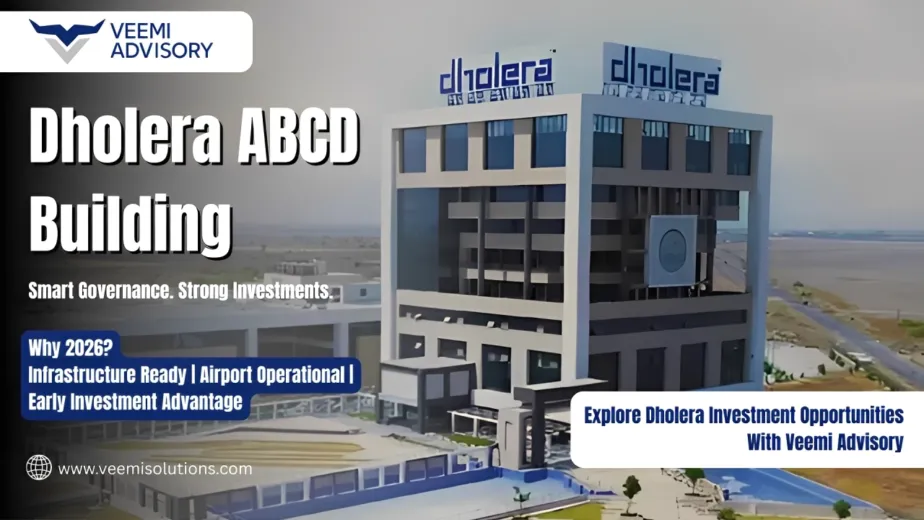
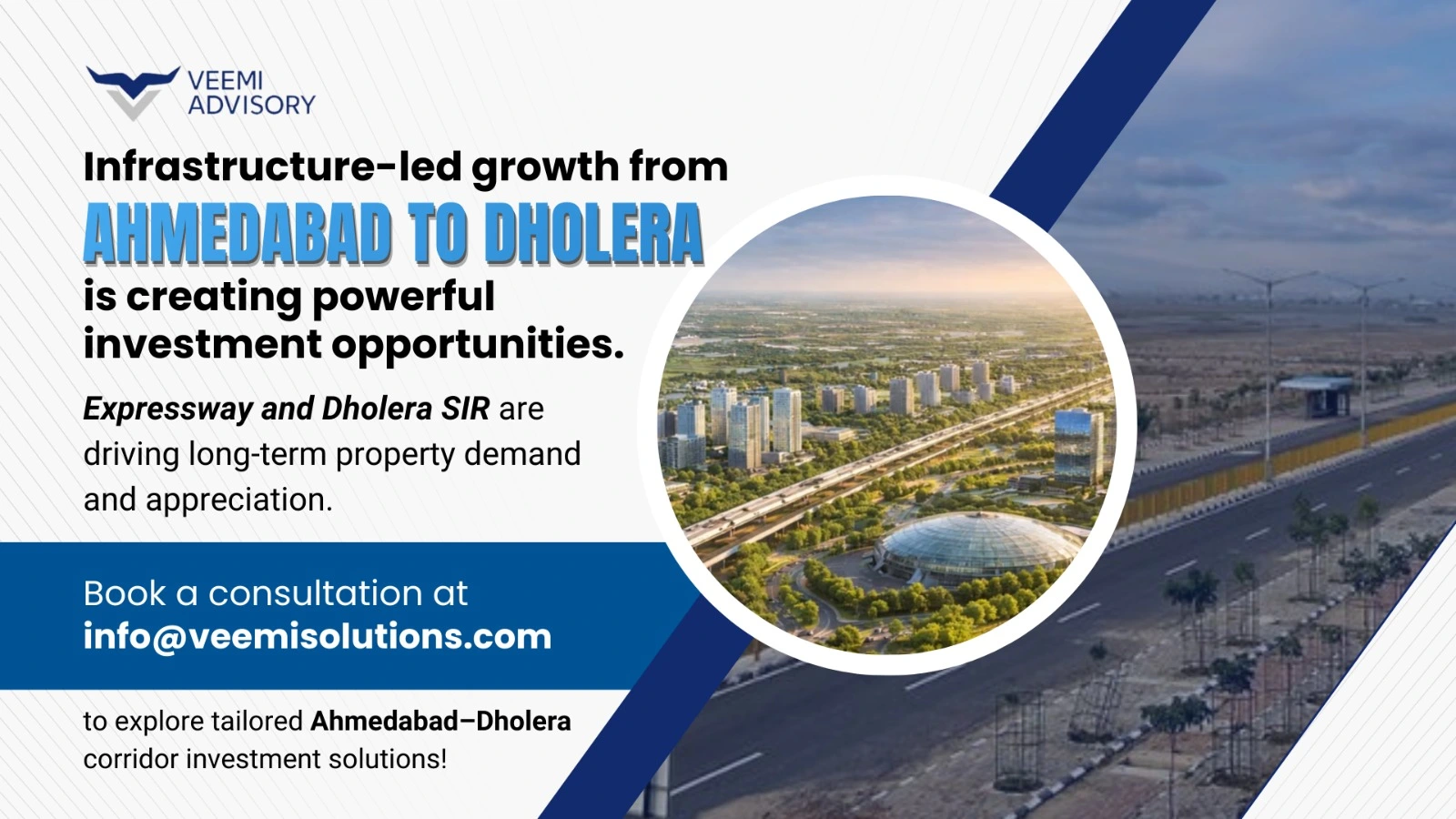
The Ahmedabad-Dholera corridor is fast emerging as one of Gujarat’s most important growth axes, driven by expressway connectivity, the development of Dholera SIR, and the upcoming international airport.
For serious investors, this corridor now represents a strategic opportunity to combine infrastructure-led appreciation with structured, medium- to long-term real estate positioning.
Why the Ahmedabad-Dholera Corridor Matters for Investors
The development of the Ahmedabad-Dholera Expressway is transforming what was once a distant peripheral belt into a high-potential investment corridor.
As connectivity improves and travel time reduces, land that was previously considered “future potential” is now moving into the active opportunity category.
This shift is especially relevant for investors seeking early entry into an infrastructure-backed micro-market before full price discovery happens.
The corridor is also closely linked to Dholera SIR (Special Investment Region), which is being developed as a smart industrial and urban hub.
This combination of road, industrial, and airport infrastructure gives investors a rare chance to participate across residential, industrial, and commercial asset classes anchored by real demand rather than pure speculation.
Commuter Infrastructure: The Core Value Driver
The expressway is the primary catalyst behind the current and expected surge in property values between Ahmedabad and Dholera. With faster, more reliable travel, the functional distance between the two locations reduces significantly, enabling:
- Easier daily or weekly commuting for professionals and business owners
- Faster movement of goods for industrial and logistics operations
- Greater confidence among developers to plan large-scale, phased projects
As key stretches become operational and ancillary roads are upgraded, surrounding villages and nodes along the alignment are likely to experience a step change in land visibility and demand.
This typically translates into progressive price appreciation, starting with speculative interest and gradually maturing into end-user-driven and business-led transactions.
How Infrastructure Is Shaping Property Value Trends
The property value surge along the Ahmedabad-Dholera belt is not random; it is closely linked to infrastructure milestones and policy-backed planning.
Some of the important value drivers include:
- Reducing travel time between Ahmedabad and Dholera, making the corridor realistic for residential, business, and logistics use.
- Proximity to Dholera International Airport, which adds a strong long-term premium for hospitality, warehousing, and high-value industries.
- Dholera SIR activation area, with core infrastructure such as roads, power, and utilities already in place, signalling readiness for actual deployment rather than plans on paper.
In many emerging corridors, land values tend to move in stages: early low-base entry, a sharp rise around key announcements, consolidation, and then renewed appreciation as infrastructure becomes visibly functional.
Ahmedabad-Dholera is currently in a phase where infrastructure visibility and completion rates are high enough to justify structured investment decisions rather than purely speculative bets.
Employment, Demand Drivers, and Livability Outlook
The Ahmedabad-Dholera corridor is not only an infrastructure story; it is also emerging as a future employment and lifestyle hub that can sustain long-term real estate demand.
Emerging Employment and Business Ecosystem
- Sectoral focus
Dholera SIR is being positioned for high-potential sectors such as manufacturing, logistics, renewable energy, technology, and allied services, creating diverse job opportunities over time.
- Industrial and logistics demand
The combination of the expressway, proximity to the upcoming international airport, and integration with larger industrial corridors is expected to attract warehousing, logistics parks, and industrial units.
- Ripple effect on surrounding markets
As projects take shape and employment hubs expand, demand for housing, retail, and support services is likely to spread along key nodes between Ahmedabad and Dholera.
Residential Demand and Long-Term Absorption
- Workforce-driven housing demand
Job creation in and around Dholera SIR will support consistent residential absorption across different budget segments, from workforce housing to mid-segment and premium options.
- Commuter-friendly living
Reduced travel time through the expressway makes it feasible for professionals to live in one node and work in another, creating corridor-wide demand rather than demand limited to a single point.
- Shift from speculation to end-user usage
Over time, as more projects become operational, the market is likely to transition from investor-led transactions to end-user-driven, stable demand, supporting more sustainable price growth.
Livability, Social Infrastructure, and Quality of Life
- Planned urban ecosystem
Dholera is being developed with a planned approach to roads, utilities, green spaces, and zoning, which can offer a more organized urban experience than many organically grown city extensions.
- Social infrastructure development
Gradual additions of schools, healthcare facilities, retail, hospitality, and recreational spaces will enhance livability and make the region more attractive to families and professionals.
- Live-work-play potential
The integrated planning approach supports a future in which residents can live close to workplaces, daily conveniences, and lifestyle amenities, thereby strengthening long-term retention and occupancy.
Investor Profiles and Suitable Strategies
Different types of investors can position themselves differently along the corridor:
Long-term Strategic Land Bankers
Best suited to acquire larger parcels in promising locations near interchanges, activation zones, or airport link roads, with a 7-10 year horizon. The priority here is clean title, compliant zoning, and aggregation potential for future joint development.
Medium-term Capital Growth Investors
Ideal for investors seeking 3-5 year appreciation with controlled risk. These investors can focus on smaller plots or project-linked land in areas where expressway work, SIR development, and nearby projects are visibly progressing. The goal is to enter before full operational status, but not at a purely speculative stage.
Yield-focused and Business Users
Entrepreneurs and businesses may look at warehousing, small industrial units, highway commercial, and service assets near key junctions. As logistics, industrial, and passenger flows increase, such assets can generate attractive operational yields in addition to capital gains.
Comparative Snapshot: Investor Profiles and Strategies
Investor type | Ideal holding period | Preferred locations | Primary objective | Risk appetite |
Long-term land banker | 7-10 years | Near expressway interchanges and SIR zones | Strategic land appreciation | Moderate to high |
Medium-term growth investor | 3-5 years | Developing nodes with visible infrastructure | Capital gains on exit | Moderate |
Yield-focused investor | 5+ years | Logistics, warehousing, highway commercial | Rental yield plus appreciation | Moderate |
Business/industrial user | 5-10 years | Industrial clusters and airport-linked areas | Operational efficiency, ownership | Low to moderate |
NRI or HNI investor | 5-8 years | Premium, well-planned corridors and projects | Diversification and long-term growth | Moderate to high |
Key Risks and How to Mitigate Them
Despite its strong potential, the Ahmedabad-Dholera corridor is still an evolving market, and a disciplined approach is essential. Investors should be especially careful about:
- Regulatory and zoning compliance: Verifying land use, applicable SIR regulations, local development plans, and restrictions around the expressway and airport influence zones.
- Title and documentation: Ensuring a clean title, proper revenue records, non-encumbrance, and complete documentation to avoid future disputes or delays in conversion and approvals.
- Execution and timeline risk: Factoring in the possibility of delays in infrastructure commissioning, slower-than-expected absorption, and extended holding periods.
- Over-optimism and overpricing: Avoiding overpayment in purely speculative pockets that lack clear infrastructure linkages, employment drivers, or formal planning.
A data-backed, due diligence-led investment process helps convert a promising story into a robust, risk-adjusted decision.
Actionable Due Diligence Checklist for Investors
Before committing capital, it is prudent to follow a structured framework:
Location Validation
- Map distance to expressway interchanges, Dholera SIR activation zones, and airport access roads
- Assess connectivity to Ahmedabad city, ring road, and other growth nodes
Legal and Technical Checks
- Title search, revenue record verification, and encumbrance checks
- Plot layout validation (road access, width, frontage, approach roads, drainage, and levels)
- Confirmation of zoning, potential for conversion (if required), and alignment with current or proposed development plans
Financial and Exit Planning
- Clear view of holding period: short, medium, or long term
- Realistic appreciation assumptions rather than aggressive projections
- Scenario planning for exit: sale to end-users, joint development, or partial liquidation of holdings
Positioning Ahmedabad-Dholera in Your Portfolio
For many investors, the Ahmedabad-Dholera belt is best suited as a thematic growth allocation within a broader real estate portfolio. Instead of replacing core, stable city assets, it can act as the growth-oriented component designed to benefit from infrastructure-led value expansion.
By spreading exposure across the points mentioned below, investors can balance upside potential with risk management:
- Strategic land banking in high-potential pockets
- Industrial and warehousing near key infrastructure nodes
- Future-ready residential or mixed-use locations near activation areas
Why Work with a Specialized Advisory Partner
Given the interplay of infrastructure, regulation, and long-term planning, working with a specialized advisory and solutions partner is critical. A competent partner can help you:
- Shortlist the most promising micro-markets and asset types along the Ahmedabad-Dholera corridor
- Conduct end-to-end legal, technical, and financial due diligence
- Structure acquisitions in line with your risk profile, investment horizon, and return expectations
- Monitor infrastructure and policy developments that may impact your holdings
If you are evaluating the Ahmedabad to Dholera corridor as part of your next investment move and want expert guidance tailored to your profile, book a consultation to discover how our solutions can help you structure, evaluate, and execute your strategy along this high-potential growth axis.
FAQs
The corridor is backed by major infrastructure projects like the Ahmedabad-Dholera Expressway, Dholera SIR, and the upcoming international airport, which together are creating strong long-term demand and appreciation potential.
Strategic land parcels near expressway interchanges, Dholera SIR activation zones, airport access roads, and emerging industrial or logistics clusters are currently considered the most attractive.
The corridor is primarily a medium- to long-term growth story; while some pockets may see faster appreciation, investors should ideally plan for a 3-10-year horizon, depending on strategy.
Key risks include title and documentation issues, zoning or regulatory non-compliance, infrastructure timeline delays, and overpaying in purely speculative locations without real demand drivers.
An expert advisory partner can help with micro-market selection, legal and technical due diligence, pricing guidance, and structured planning aligned with your risk profile and investment goals.
The ideal budget depends on the asset type. Still, investors can typically begin with smaller plot investments near developing nodes and scale up to larger land parcels or commercial assets as capital and risk appetite grow.
Yes, the Ahmedabad-Dholera corridor is well-suited for NRI and HNI investors seeking long-term, infrastructure-backed growth, portfolio diversification, and exposure to a planned smart-city ecosystem.