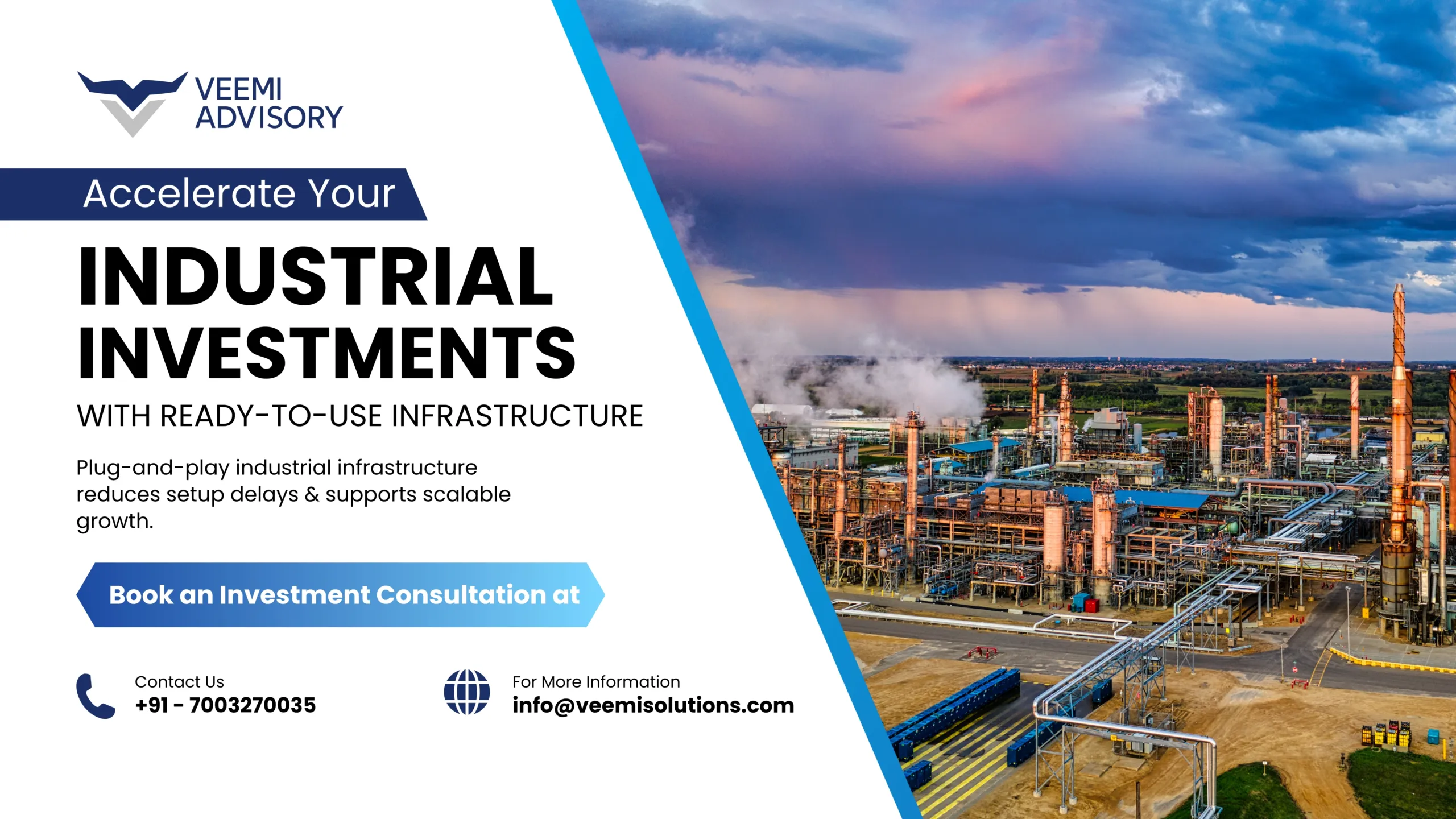
What Makes Plug-and-Play Industrial Infrastructure Important for Global Companies?
Global companies no longer choose industrial destinations solely on land costs or location. What matters more today is execution readiness.
Businesses want industrial sites where utilities, roads, logistics, and support systems are already in place so operations can begin faster and with fewer risks.
This is why plug-and-play industrial infrastructure has become increasingly important. It gives companies the confidence to enter a market, commission projects faster, and scale with less uncertainty.
For investors, it also improves visibility into project viability, demand readiness, and long-term commercial value.
What Is Plug-and-Play Industrial Infrastructure?
Plug-and-play industrial infrastructure refers to industrial locations where the basic systems required for business operations are already in place or delivered in a coordinated manner.
Instead of waiting for core services to be built after land acquisition, companies can move into an environment that is closer to operational readiness.
Core Elements of Plug-and-play Infrastructure
- Internal roads
These support movement of goods, machinery, and workforce from the start.
- Reliable power supply
Stable electricity is essential for manufacturing, warehousing, and technology-led operations.
- Water, sewage, and drainage systems
These are critical for daily functionality, compliance, and future expansion.
- Digital infrastructure
Smart connectivity and monitoring systems support efficient industrial management.
- Integrated utility planning
Utilities that are designed together reduce delays, duplication, and future disruption.
In simple terms, plug-and-play infrastructure reduces the gap between land acquisition and actual business execution.
Why Global Companies Prioritize Infrastructure Readiness
Global companies work with fixed production schedules, supply chain commitments, and capital allocation timelines. They cannot afford unpredictable delays caused by incomplete infrastructure.
What Global Companies Typically Look For
- Faster project commissioning
- Lower operational uncertainty
- Better logistics connectivity
- Utility reliability
- Easier scalability
- Stronger compliance support
These factors matter because even a strong industrial location can lose its appeal if businesses must wait too long for roads, power, or water access to become functional.
Why Readiness Matters More than Low Entry Cost
A lower land price may appear attractive at first, but it does not always translate into better business value. If a company has to spend extra time and capital to address basic infrastructure gaps, the total cost of delay can exceed the initial savings.
That is why the infrastructure development timeline India presents in industrial destinations has become an important factor for global companies. A location with clear infrastructure sequencing and visible progress is often more valuable than one that offers only a lower acquisition cost.
How Plug-and-Play Infrastructure Reduces Risk for Investors
Plug-and-play industrial infrastructure is not only useful for occupiers. It is also highly relevant for investors because it reduces execution risk and improves commercial confidence.
Key Investor Benefits
- Shorter gestation periods
Projects move more quickly from acquisition to activation.
- Lower hidden infrastructure costs
Investors face fewer unexpected expenses linked to missing core systems.
- Stronger occupier demand
Businesses are more likely to choose locations that support faster setup.
- Better predictability of returns
Greater infrastructure clarity supports more informed investment planning.
Why this Matters Commercially
Investors assess more than land appreciation. They also evaluate whether a destination can attract quality occupiers, support long-term industrial activity, and sustain commercial momentum. Infrastructure readiness improves all three.
A site with integrated roads, utilities, and connectivity is easier to underwrite than one dependent on future promises.
Infrastructure Features Global Companies Evaluate
Before selecting an industrial destination, global companies usually review the infrastructure stack in detail.
Reliable power and redundancy
Power is one of the first things businesses assess. Industrial operations require an uninterrupted supply, especially in sectors such as advanced manufacturing, engineering, electronics, and logistics.
Water security and treatment systems
Water availability alone is not enough. Companies also evaluate wastewater systems, treatment capacity, and long-term water management to ensure reliable operations.
Internal roads and external connectivity
Strong internal mobility supports smooth operations inside an industrial zone, while external connectivity improves movement to ports, airports, highways, and markets.
Digital backbone
Digital systems now play a critical role in industrial environments. Monitoring, control, and communication infrastructure can improve efficiency and reduce operational complexity.
Environmental and compliance readiness
Global companies increasingly look for industrial ecosystems that support environmental management, safety standards, and long-term regulatory compliance.
Comparison: Conventional Setup vs Plug-and-Play Infrastructure
Factor | Conventional Industrial Setup | Plug-and-Play Industrial Infrastructure |
Utility readiness | Often phased in later | Planned and delivered in advance |
Time to commissioning | Slower | Faster |
Execution uncertainty | Higher | Lower |
Occupier appeal | Moderate | Stronger |
Infrastructure coordination | Fragmented | Integrated |
Scalability | More difficult | Easier |
Investor visibility | Limited | Clearer |
Current Industry Challenges This Model Helps Solve
Plug-and-play industrial infrastructure directly addresses several challenges facing industrial development today.
Key Issues it Helps Solve
- Delays caused by incomplete utilities
Businesses do not want to wait for power, water, and roads after project commitment.
- Rising setup costs
Fragmented infrastructure often requires additional coordination and higher capital expenditure.
- Uncertain execution timelines
This is where the infrastructure development timeline India offers becomes especially important.
- Difficulty attracting global occupiers
Underprepared zones are less attractive to companies with strict setup schedules.
- Pressure for operational resilience
Modern industrial users want infrastructure that is reliable, integrated, and future-ready.
Why Strategic Advisory Matters Alongside Infrastructure
Even when infrastructure appears strong, investors still need to interpret timing, sector fit, and risk correctly. A location may look promising on paper, but differ significantly in terms of real readiness and market alignment.
Strategic advisory helps investors:
- Understand project sequencing
- Evaluate execution risk
- Assess market demand
- Compare opportunities more effectively
- Make decisions based on long-term value rather than short-term narrative
This becomes especially important in emerging industrial destinations where infrastructure planning and commercial maturity may evolve at different speeds.
Strategic Advantage Through Ready Infrastructure
Plug-and-play industrial infrastructure transforms land into an execution-ready asset. Businesses gain faster deployment and operational certainty, while investors benefit from clearer risk visibility and stronger long-term value. In today’s competitive industrial landscape, readiness drives scalability, efficiency, and confidence.
Book a consultation to discover how our solutions can help you assess infrastructure readiness, optimize project timelines, and unlock high-potential industrial investments.
FAQs
It refers to industrial locations where core systems such as roads, power, water, drainage, and connectivity are already planned or operational, enabling faster business setup.
It helps global companies reduce setup delays, lower operational uncertainty, and scale more efficiently.
It improves project visibility, reduces execution risk, and makes industrial locations more attractive to potential occupiers.
Because delays in utilities and logistics can increase overall project cost far more than the savings from cheaper land.
They should review utility readiness, connectivity, scalability, project timelines, and the location’s overall commercial viability.