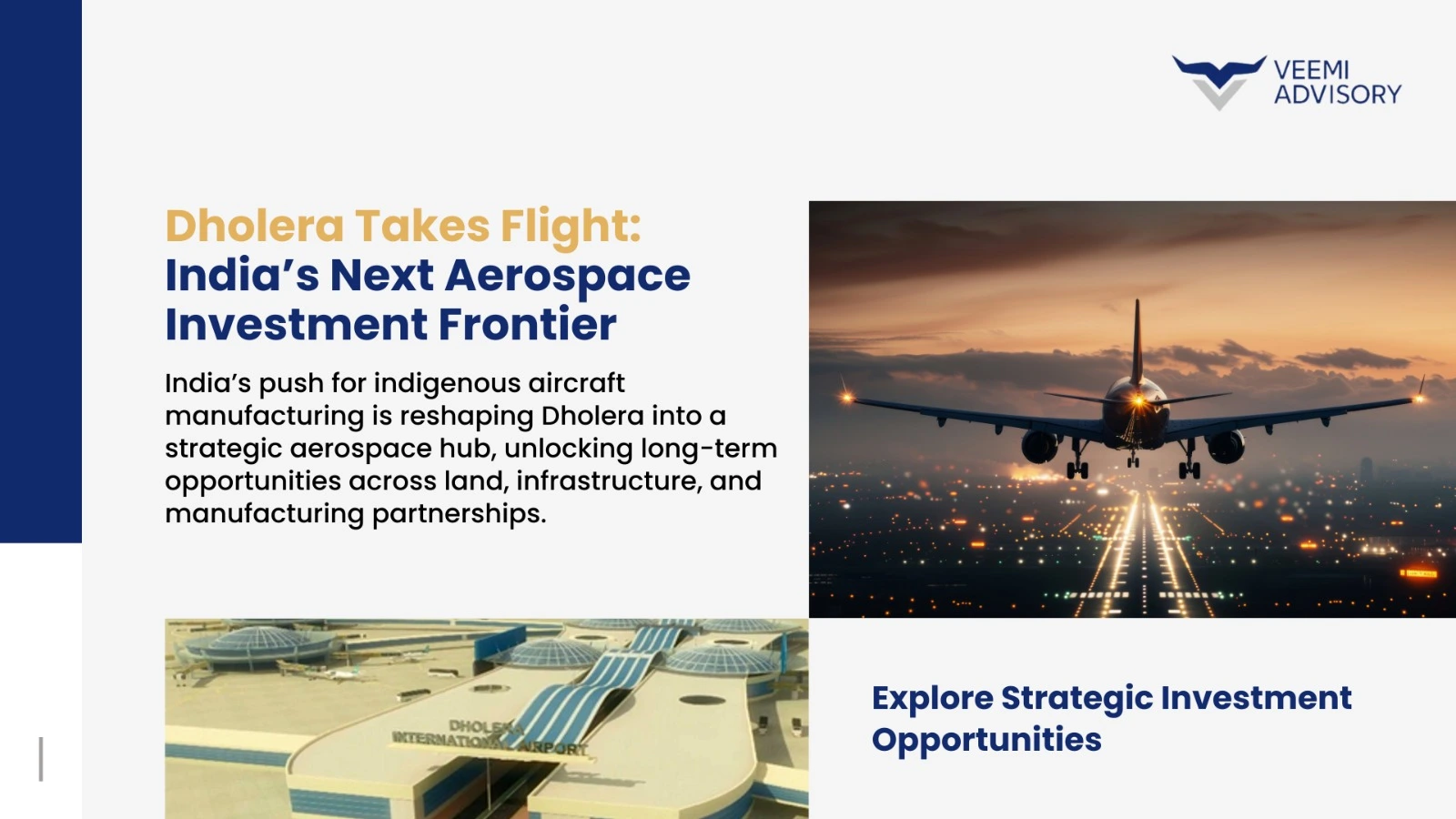
India’s Indigenous Aircraft Manufacturing Revolution: A New Era for Dholera Investment
The Dawn of ‘Make in India’ in Aviation
India’s civil aviation sector is entering a decisive growth phase. Already among the world’s largest aviation markets, India is experiencing sustained double-digit passenger growth, driven by a rising middle class, regional connectivity initiatives, and rapid airport expansion. Yet, despite being a global leader in space technology and defense aviation, India has historically depended almost entirely on imported commercial aircraft.
That contradiction is now being addressed. With a strong policy push under Make in India and Atmanirbhar Bharat, the country is laying the foundation for indigenous aircraft manufacturing. At the center of this transformation is Dholera Special Investment Region (DSIR), positioned to become India’s next major aerospace and aviation manufacturing hub.
India’s Aircraft Manufacturing Journey: From Dreams to Reality
The Pioneers
India’s aerospace story did not begin today. Institutions like Hindustan Aeronautics Limited (HAL) have over eight decades of experience in aircraft and engine manufacturing. Early efforts such as the NAL Saras project represented India’s first serious attempt at an indigenous civil aircraft. Private innovators like Thrust Aircraft and the steady success of platforms such as Tejas, Dhruv helicopters, and Dornier 228 further strengthened domestic capabilities.
These programs built technical confidence, supply chains, and skilled manpower, critical ingredients for scaling into commercial aviation.
The Challenges
Despite progress, civil aircraft manufacturing remains one of the most complex industrial undertakings in the world. India has faced persistent challenges, including:
- Dependence on foreign technology and certification ecosystems
- Capital requirements exceeding ₹10,000 crore per program
- Lengthy certification cycles under DGCA and international regulators
- The dominance of the Boeing-Airbus duopoly, which controls most of the global market
Overcoming these barriers required a decisive structural shift, one that blends global expertise with Indian manufacturing depth.
The Game‑Changer: Tata-Airbus C‑295 Partnership
Historic Deal Overview
The Tata-Airbus C‑295 program marked a watershed moment for Indian aerospace manufacturing. Valued at approximately USD 2.8 billion, the contract covers 56 aircraft for the Indian Air Force, with a clear roadmap for domestic production. While the initial aircraft are supplied from Spain, the majority will be manufactured in India over a ten‑year delivery horizon.
This partnership represents India’s first full‑scale private‑sector aerospace manufacturing program covering the entire lifecycle, from assembly and testing to delivery.
Manufacturing and Capability Development
Beyond aircraft assembly, the program is catalyzing deep capability creation:
- Indigenous electronic warfare systems
- Advanced aerostructure manufacturing
- Skill development across design, quality, and systems integration
The employment impact alone is significant, with tens of thousands of direct and indirect jobs expected across the supply chain.
Dholera: The Emerging Aerospace Manufacturing Hub
Why Dholera?
Dholera’s selection is not incidental. Located along the Delhi-Mumbai Industrial Corridor (DMIC), it offers unmatched connectivity, scale, and planning advantages. Just 80 km from Ahmedabad, Dholera combines proximity to an urban talent pool with the benefits of a greenfield industrial city. Government‑backed infrastructure, early‑bird project status, and integrated urban planning make DSIR uniquely investment‑ready.
The aerospace push is not an isolated development. It builds on Dholera’s broader positioning as a future-ready industrial ecosystem designed to host high-value, technology-intensive manufacturing across sectors. Electronics, semiconductors, defense, and advanced engineering are already shaping the region’s industrial narrative.
To understand how aerospace manufacturing fits into Dholera’s larger industrial strategy, explore: Dholera Set to Become India’s Next High-Tech Manufacturing Hub.
Dholera International Airport
A cornerstone of this vision is the Dholera International Airport, spread across more than 1,400 acres. Designed with long runways suitable for testing and wide‑body operations, the airport is expected to be operational by late 2025. Dedicated commercial and aviation‑linked development zones further enhance its role as an aerospace catalyst.
The airport’s role extends far beyond passenger movement. Its long runways and dedicated aviation land make it a critical enabler for aircraft testing, MRO operations, cargo logistics, and aerospace manufacturing activity. As seen in similar global aviation hubs, airport-led infrastructure has historically triggered sharp land value re-rating and industrial clustering.
For a deeper analysis of how airport commissioning is expected to impact land prices, industrial demand, and investor returns, read: Dholera International Airport: How It Will Transform Real Estate Prices in 2026 and Beyond?
The Aviation Zone Vision
The long‑term plan extends well beyond aircraft assembly:
- Aircraft and aerostructure manufacturing units
- MRO (Maintenance, Repair, and Overhaul) facilities
- Aviation academies and flight training institutes
- A dense ecosystem of component suppliers and offset partners
This clustering effect is what transforms Dholera from an industrial estate into a full aerospace city.
Investment Opportunities in Dholera’s Aerospace Ecosystem
Direct Manufacturing Opportunities
Each aircraft program requires thousands of components, creating opportunities in:
- Precision components and assemblies
- Avionics and electronics
- Engine parts and spares
- Composite structures and aerostructures
Supporting Infrastructure Investments
Manufacturing growth drives parallel demand for:
- Industrial land and logistics parks
- Warehousing and cold‑chain facilities
- Worker housing and integrated townships
- Skill development and training centers
Service Sector Opportunities
As the ecosystem matures, high‑value services gain importance:
- MRO for civil and defense aircraft
- Engineering and certification services
- Testing and quality assurance labs
- Research and development centers
Government Initiatives Supporting the Sector
India’s aerospace ambitions are reinforced by policy support, including:
- Make in India aerospace policy
- Production Linked Incentive (PLI) schemes
- Liberalized FDI norms, including 100% FDI in defense manufacturing
- UDAN regional connectivity program
- Special incentives applicable within the DSIR and SEZ frameworks
These measures significantly reduce entry barriers for long‑term investors.
Economic Impact and Growth Projections
Market Potential
India remains under‑penetrated in air travel compared to global peers, indicating substantial latent demand. Industry estimates suggest domestic requirements for hundreds of light and medium aircraft over the coming decades, alongside export opportunities to emerging markets.
Dholera’s Growth Outlook
With sustained policy backing, Dholera could host:
- Large‑scale aircraft manufacturing over multiple decades
- An ecosystem of more than 100 suppliers
- Employment for over 50,000 skilled professionals
- Aerospace investments running into tens of thousands of crores
Investment Risks and Mitigation
Key Risks
- Infrastructure and execution delays
- Technology absorption challenges
- Certification timelines and global competition
- Cyclical demand fluctuations
Mitigating Factors
Strong government commitment, anchor partnerships like Tata-Airbus, captive defense demand, and long‑term aviation growth trends collectively mitigate these risks.
Comparative Perspective: Why Dholera Stands Out
While cities like Bangalore, Hyderabad, and Vadodara have established aerospace footprints, Dholera offers scale, integrated planning, and first‑mover advantages unavailable in legacy hubs. Its greenfield nature enables purpose‑built infrastructure aligned with next‑generation aerospace needs.
Investment Strategy for Veemi Advisory Clients
Timeline‑Based Approach
- Short term (2025-2027): Strategic land acquisition near the airport and aviation zones
- Medium term (2027-2030): Manufacturing and service‑sector entry
- Long term (2030+): Ecosystem expansion and export‑oriented growth
Investment Categories
- Land banking in high‑potential zones
- Industrial plots for suppliers
- Commercial real estate near the airport
- Residential developments for workforce housing
- Strategic partnerships with aerospace OEMs and Tier‑1 suppliers
A Once‑in‑a‑Generation Opportunity
Dholera’s transformation represents more than industrial growth; it signals India’s re‑entry into global civil aircraft manufacturing. Aligned with national priorities and backed by institutional partnerships, Dholera offers early investors a rare chance to participate at the ground floor of a long‑cycle, high‑impact sector.
Veemi Advisory plays a critical role in helping investors navigate this complexity with data‑driven insights, regulatory clarity, and strategic positioning.
For investors seeking early exposure to India’s aerospace manufacturing future, Dholera presents a compelling opportunity. Connect with Veemi Advisory for detailed investment assessments, location strategies, and partnership opportunities within the Dholera aerospace ecosystem.
FAQs
Unlike legacy hubs that evolved organically over decades, Dholera is a planned greenfield industrial city. This allows purpose-built zoning for aviation manufacturing, integrated logistics, proximity to a new international airport, and scalability that mature cities cannot easily offer.
No. While defense programs such as the C‑295 provide initial scale and stability, the long-term vision includes civil aircraft manufacturing, MRO for commercial airlines, flight training, and export-oriented component manufacturing.
Dholera is suitable for long-term investors such as HNIs, family offices, NRIs, industrial groups, and institutional investors who understand infrastructure-led growth cycles and are comfortable with phased capital deployment.
Land and infrastructure-led appreciation typically follows airport commissioning and anchor tenant operations. For Dholera, meaningful value inflection is expected in phases between 2026 and 2030 as aviation activity scales.
The airport is a key catalyst. Beyond passenger traffic, its long runways enable aircraft testing, MRO operations, cargo movement, and training activities, functions that directly support aerospace manufacturing and services.
Aerospace manufacturing relies heavily on Tier‑2 and Tier‑3 suppliers. Precision machining, electronics, composites, tooling, and quality services offer substantial opportunities for mid-sized Indian manufacturers entering global supply chains.
Policy support through PLI schemes, FDI liberalization, infrastructure funding, and DSIR-specific incentives lowers entry barriers, improves project viability, and enhances long-term predictability for investors.
India currently sends a significant portion of aircraft MRO work overseas. Dholera’s location, airport infrastructure, and cost advantages position it well to capture domestic and regional MRO demand over the next decade.
Aerospace-led development is capital-intensive and long-cycle in nature. Dholera is best approached as a strategic, medium- to long-term investment rather than a short-term speculative play.
Veemi Advisory provides end-to-end support, including location strategy, regulatory clarity, ecosystem mapping, risk assessment, partnership identification, and phased investment planning aligned with aerospace sector timelines.