Dholera SIR Explained: Zones, Town Planning, and Investment Logic
Dholera Special Investment Region (SIR) is often described as India’s most ambitious smart city project. But beyond the headlines, glossy brochures, and price projections, what truly defines Dholera is how systematically it is planned and why that planning matters for investors.
This is not a story of overnight growth or speculative real estate. To understand its investment potential, one must first understand its structure. This article explains Dholera SIR in depth – its zoning framework, planning logic, and how investors should interpret it in 2026.
What is Dholera SIR (Special Investment Region)?
Dholera SIR (Special Investment Region) is a legally designated economic and development region in Gujarat, created to promote industrial growth, infrastructure development, and planned urbanization under a single regulatory framework.
It is officially notified under the Gujarat Special Investment Region Act and developed as part of the Delhi-Mumbai Industrial Corridor (DMIC). The region spans over 920 sq. km, making it one of India’s largest planned urban–industrial zones.
Unlike cities that evolve organically over decades, Dholera is being built as a greenfield city, meaning:
- No legacy congestion
- No unplanned growth
- No retrofitting of infrastructure later
In nutshell, the region is governed by the Dholera Special Investment Regional Development Authority (DSIRDA), which oversees planning, zoning, approvals, and execution. For investors who want clarity and safe guidance, Veemi RE Advisory Services offers expert support on lease & contract negotiation, and investment planning in Dholera SIR.
The Core Planning Philosophy Behind Dholera
Dholera is not designed to grow outward randomly. Its planning follows a top-down, layered approach, where every element-roads, utilities, industries, residential zones is mapped before development begins.
This plan does not sell land, it defines how land will be used. The second layer is the Town Planning (TP) Schemes, which convert the Development Plan into executable ground reality.
At the highest level is the Development Plan (DP). The DP outlines:
- Land use classification
- Industrial corridors
- Residential clusters
- Commercial districts
- Transport networks
- Environmental buffers
The Simple & Straightforward Understanding of Zoning in Dholera SIR
Zoning is the backbone of Dholera’s development. It divides the entire region into specific areas based on purpose, ensuring that the city grows in a planned and organized way rather than through random expansion. Each zone has a defined economic and urban role, and understanding these zones is essential for any investor.
Dholera Industrial Zones
Industrial zones are the core of Dholera SIR. These areas are designed to support large-scale manufacturing and high-tech industries, making Dholera a high-tech manufacturing hub in the future.
The zones are planned for:
- Manufacturing
- Electronics and semiconductors
- Electric vehicles (EVs)
- Logistics and warehousing
- Renewable energy
- Other dholera industrial investment sectors
Dholera Residential Zones
Residential zones in Dholera are not planned as standalone housing projects. Unlike traditional cities where housing is developed first and jobs follow later, Dholera’s residential growth is dependent on industrial activation. This makes the housing demand more sustainable and long-term.
Including…
- Industrial employees
- Administrative staff
- Service professionals and support staff
Dholera Commercial & Mixed-Use Zones
They act as connectors between industrial zones and residential areas, helping create a balanced ecosystem rather than isolated pockets of development.
These areas include…
- Offices
- Retail spaces
- Business services
- Hospitality
Dholera Transport & Utility Zones
A significant portion of Dholera’s land is dedicated to transport and utility infrastructure. These zones are essential because they support the entire city’s functionality and long-term growth.
Typical infrastructure zones include:
- Major road networks and expressways
- Rail and freight corridors
- Water supply and treatment systems
- Power and energy infrastructure
- Public utilities and smart city systems
Additionally, key infrastructure elements that strengthen Dholera’s investment case include:
- Dholera Airport (improves connectivity and business access)
- Dholera-Bhavnagar railway line (boosts logistics and transport efficiency)
What are Town Planning (TP) Schemes & What They Represent?
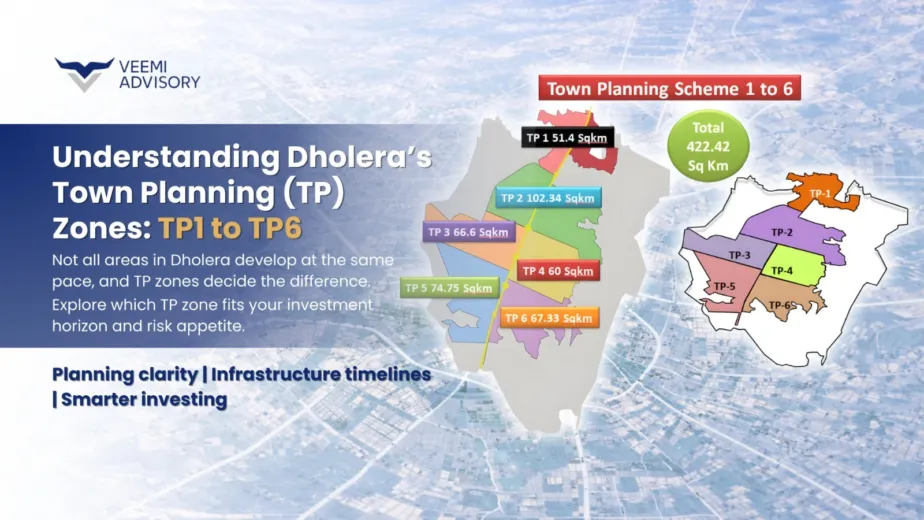
Town Planning (TP) Schemes are the execution units of Dholera’s master plan. While the master plan sets the overall vision, TP schemes convert it into real development by dividing the region into smaller, manageable zones with defined plots, roads, and utilities.
In Dholera SIR, there are six TP schemes (TP1 to TP6), each representing a specific phase of development.
Dholera TP scheme represents:
TP1: The first execution zone with core infrastructure and early industrial development. It offers the highest planning certainty but usually comes with higher entry prices.
TP2: Contains the Activation Area, where industrial operations, utilities, and early city activity begin. This zone marks the transition from planning to functioning development.
TP3: Supports residential and mixed-use growth aligned with transport corridors. It acts as the bridge between early development and broader city expansion.
TP4: Linked to major infrastructure routes and future connectivity projects. It offers strategic positioning but depends on execution timelines.
TP5 & TP6: Planned for long-term expansion, these zones usually have lower entry prices but require longer patience and depend on overall city maturity.
The Investment Logic of Dholera SIR
Dholera SIR follows an infrastructure-first, demand-later development model, where growth is planned in clearly defined phases rather than rapid, speculative expansion.
Phase 1: Infrastructure Creation
This phase is driven primarily by government investment. Core infrastructure such as roads, utilities, and connectivity is developed first. Returns are not immediate, but planning clarity and execution certainty are at their highest during this stage.
Phase 2: Industrial Activation
Once infrastructure is in place, industrial and manufacturing units begin operations. This leads to job creation, workforce movement, and growing investor confidence. This phase marks the transition from planning to functional activity.
Phase 3: Residential and Commercial Demand
As employment stabilizes, population growth follows. Housing, retail, and commercial demand become functional, driven by real usage rather than speculation. This is when the city begins to operate as a self-sustained urban ecosystem.
Conclusion
Dholera SIR is not a speculative story, it is a long-term infrastructure and industrial transformation project. The real difference between a smart investment and a costly mistake lies in where you invest, what you verify, and how well you understand the planning framework.
This is where Veemi Real Estate Advisory plays a crucial role. By offering zoning clarity, TP scheme verification, legal due diligence, and investment structuring, we aim to help investors navigate Dholera with facts rather than promises.
FAQs
TP scheme status, zoning classification, land title, approvals, and alignment with the Dholera master plan.
Yes. It is officially notified under the Gujarat Special Investment Region Act and is part of the Delhi-Mumbai Industrial Corridor (DMIC).
Dholera Smart City is a part of Dholera SIR. The SIR is the larger region; the Smart City is the planned urban area within it.
Yes. NRIs can invest in permitted property types, subject to RBI and FEMA guidelines.