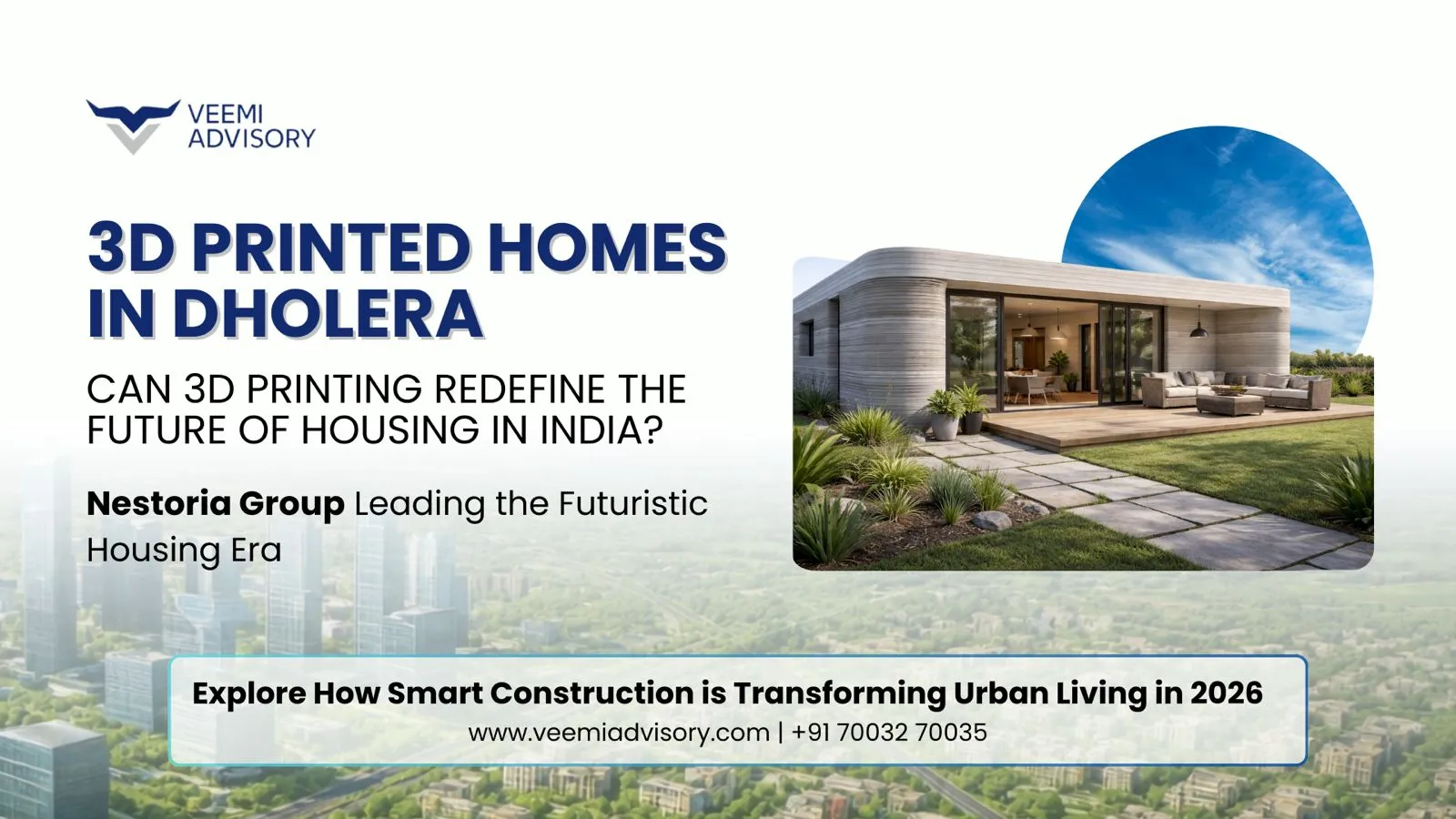
3D-Printed Homes in Dholera – Nestoria Group Leading the Futuristic Housing Era!
Hold onto your hard hats – because construction in India just got a sci-fi makeover! Imagine entire neighborhoods “printed” out of concrete by giant robots, rising in days instead of months. Sounds like the future? Well, Nestoria Group is making it real in Dholera Smart City.
Curious how it works, why Dholera was chosen, and what it means for the future of housing, investment, and urban living? Buckle up, this is construction as you’ve never seen before.
Nestoria Group: Leading India’s 3D-Printed Housing Revolution
If you thought 3D printing was only for gadgets and prototypes, think again. Nestoria Group is bringing this tech to life-size homes, and in Dholera Smart City, no less!
With this initiative, Nestoria is positioning Dholera as the laboratory for futuristic housing in India – and investors, urban planners, and tech enthusiasts are already watching closely.
Here’s what makes Nestoria a trailblazer:
High-Tech Construction: Uses layer-by-layer 3D printing to build strong, crack-resistant structures.
Speed Like Never Before: Homes that traditionally take months to build now rise in days.
Sustainability at Core: Minimizes material waste and reduces carbon footprint.
Scalable Solutions: Technology can be replicated for entire smart cities, not just a few homes.
Future-Ready Design: Homes built to integrate modern urban amenities and smart city infrastructure.
What Makes Dholera The Perfect Playground for 3D-Printed Homes?
You might wonder, why did Nestoria pick Dholera of all places? The answer is simple: Dholera is ready for the future, and this project fits like a glove.
Here’s why Dholera is the ultimate launchpad for India’s 3D-printed housing revolution
Smart City Infrastructure: As India’s first planned greenfield smart city, Dholera offers ready-to-develop land, integrated roads, power grids, and logistics corridors, making large-scale 3D construction feasible.
Strategic Connectivity: Nestled along the Delhi-Mumbai Industrial Corridor (DMIC), Dholera connects seamlessly with major urban centers, ports, and industrial hubs, perfect for materials, workforce, and future residents.
Investor-Friendly Policies: The Gujarat government supports smart construction and innovative technology projects through incentives, streamlined approvals, and infrastructure support.
Scalable Space: Unlike crowded cities, Dholera provides ample room for expansion, allowing Nestoria to scale 3D printing across entire neighborhoods.
Urban Innovation Hub: With its smart city vision, Dholera is designed for experimentation with futuristic technologies, from automated construction to green energy integration.
Dholera Sees India’s First Large-Scale 3D-Printed Homes by Nestoria Group.
Dholera, Gujarat, February 24, 2026: In a historic first for India, Nestoria Group, in partnership with GB Group, unveiled the nation’s first large-scale 3D-printed homes at Dholera Smart City. The announcement, made in the presence of city officials and industry experts, signals a new era in construction and urban housing.
Speaking at the launch, Nestoria Group’s leadership said, “This project is not just about building homes, it is about demonstrating how speed, precision, and sustainability can redefine India’s cities.”
Officials highlighted that the initiative is in line with India’s Viksit Bharat 2047 vision, underscoring the nation’s ambition to become developed, technologically advanced, and sustainable by its centenary of independence.
Dholera 3D Printing Homes – Learning the Basics!
Think of it like this: instead of bricks and mortar being laid by hand, a robotic arm “prints” your house layer by layer, almost like a giant 3D printer bringing blueprints to life.
So, what exactly are 3D-printed homes?
In simple terms, these are houses built using a giant 3D printer instead of traditional bricks and cement. The printer lays down layers of special concrete, one after another, until the house is complete.
Here’s the breakdown
Layer-by-Layer Precision: The 3D printer deposits specially engineered concrete in thin layers, building walls, curves, and intricate designs with millimeter accuracy.
Automated Construction: Robots handle most of the work, reducing human error and speeding up construction timelines.
Material Optimization: Only the exact amount of concrete is used, drastically reducing waste compared to traditional methods.
Fast Build Times: What normally takes months to construct, 3D printing accomplishes in days, without compromising strength or durability.
Customization & Design Flexibility: Want unique curves, patterns, or modular designs? 3D printing makes architectural creativity scalable.
Sustainable Practices: Less waste, fewer vehicles transporting materials, and lower carbon emissions make this eco-friendly and green.
Nestoria X Dholera 3D-Printed Housing Project Scope
Nestoria’s debut in Dholera isn’t just a pilot; it’s a full-scale, futuristic residential project designed to transform urban housing in India. Here’s everything you need to know:
Project scope
Scale: Large-scale 3D-printed housing spanning multiple residential blocks.
Units: Hundreds of affordable, sustainable homes planned in the initial phase.
Technology: Automated 3D concrete printing machines, enabling rapid construction.
Design: Modern, modular, and eco-friendly homes designed for smart city living.
Timeline: Phased rollout, with the first units expected within a few months, and full-scale readiness by 2030.
Look into the History and Evolution of 3D Construction
While 3D printing is often associated with prototyping in industries like aerospace and manufacturing, its application in construction is relatively recent:
Timeline
1980s-1990s: 3D printing technology emerged in industrial manufacturing. Early applications were small-scale, focused on prototyping plastic and resin components.
Early 2000s: Contour crafting, developed by Behrokh Khoshnevis, introduced large-scale 3D printing for walls and structural components.
2010s: Startups like Apis Cor and ICON began experimenting with 3D-printed homes. Demonstrations included printing a single-story house in under 24 hours.
2020s: The technology moved from proof-of-concept to real-world deployment, including multi-story buildings, villas, and commercial structures. Companies like COBOD and Winsun have pioneered scalable applications.
How 3D Printing Works in Construction?
At its core, 3D printing in construction is layered material deposition, guided by digital blueprints.
The main components include
Design Software: CAD (Computer-Aided Design) and BIM (Building Information Modeling) software create a 3D model of the house.
Printer Mechanics: Large-scale printers can use gantry systems, robotic arms, or mobile tracks to deposit material.
Material Extrusion: Special concrete, polymers, or composites are extruded through nozzles layer by layer.
Automation and Sensors: Modern printers use sensors to ensure alignment, monitor curing, and maintain precision.
Materials Used in 3D-Printed Homes
Material selection is critical for durability, safety, and performance.
Common materials include
Concrete-Based Mixes: The most widely used. Can be reinforced with fibers or polymers to enhance strength.
Geopolymers: Eco-friendly alternative to cement with a lower carbon footprint.
Composite Materials: Mixtures of concrete with plastics or recycled waste materials for insulation or reduced weight.
Mortar Mixtures: For finer applications like walls and partitions.
Biodegradable or Recycled Materials: Emerging research includes 3D printing with clay, sand, or organic composites for sustainable housing.
Quick Step-by-Step Process of Printing a Home
The following shows exactly how a home is printed, step by step, using 3D printing technology.
Home Printing Process
Digital Design: Create 3D blueprints using CAD and BIM.
Material Preparation: Mix concrete or composite materials.
Printer Setup: Place gantry or robotic-arm printer on-site.
Layer Printing: Deposit layers in succession to build walls and partitions.
Curing and Reinforcement: Allow material to harden; reinforce where needed.
Roofing and Interiors: Install roofs, windows, doors, plumbing, and electrical systems.
Finishing: Apply paint, insulation, flooring, and furnishings.
Nestoria Group’s Long-Term Vision
The Dholera project is not just a single housing initiative but a template for future smart city residential development in India.
Nestoria Group aims to:
- Lead India’s 3D construction movement, demonstrating scalability and efficiency.
- Set new benchmarks in housing quality, speed, and sustainability
- Integrate with smart city ecosystems, ensuring modern homes for modern urban communities.
Investor Insights
While the 3D-printed homes in Dholera are still in the early stages, the initiative has caught the attention of real estate investors, developers, and technology-focused funds.
Key points for investors
- Weigh technology adoption risks, project timelines, and residential demand before making an investment decision.
- Streamlined approvals and incentives reduce risk; analyze policy stability and long-term support.
- 3D printing enables faster delivery and lower labor costs; check potential timelines against traditional construction.
- Nestoria Group + GB Group are pioneering 3D-printed homes in India; consider their experience and track record before investing.
- Dholera Smart City offers strategic connectivity and infrastructure; assess how this impacts residential demand and land value.
Looking Ahead
The Dholera project is a first step toward large-scale adoption of 3D-printed residential construction in India. While the homes are still in the planning and initial launch phase, the project demonstrates how technology, innovation, and urban planning can intersect to redefine modern housing.
As India moves toward smart city development, initiatives like this could shape the future of sustainable and high-tech urban living.
Conclusion
The launch of India’s first large-scale 3D-printed homes by Nestoria Group in Dholera Smart City marks a significant milestone in construction and urban development. While the homes are still in early stages, the project demonstrates the potential of innovative, sustainable, and scalable residential solutions in a smart city context.
To navigate these opportunities effectively, partnering with experts like Veemi RE Advisory can help investors make informed decisions, evaluate market potential, and identify high-growth smart city projects.
FAQs
3D-printed homes are houses built using large-scale 3D printers that lay concrete or composite materials layer by layer, instead of using traditional bricks and mortar.
Yes. They use less material, produce minimal waste, and reduce carbon emissions, supporting sustainable construction practices.
Investors can monitor trends in smart city residential growth, scalable construction, and innovative housing technology to make informed decisions.
Yes, 3D printing allows modular and flexible designs, enabling unique layouts and modern urban living features.
Thanks to 3D printing, homes can be constructed in days instead of months, speeding up project timelines significantly.